The Waters Call
by Diane Jarvenpa
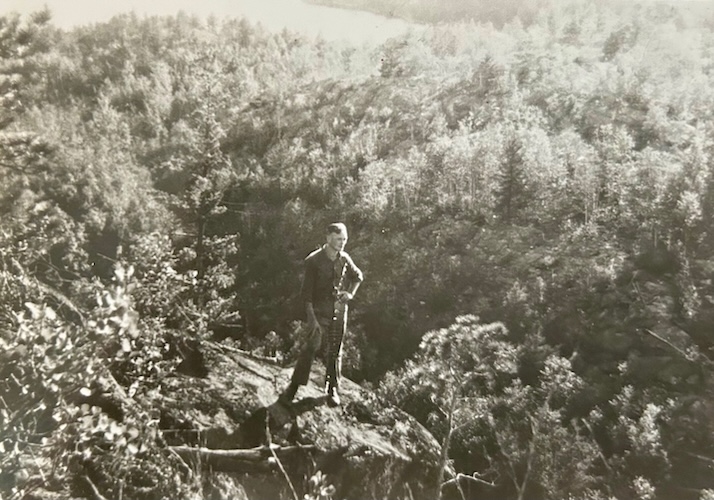
My father was a boy of the wilderness. A boy of the north country. He grew up in Embarrass, Minnesota and was raised by his father and extended family when he lost his mother to the Spanish Flu pandemic at the age of two. He was shy and he found himself often walking the woods. This was his sanctuary. He went to Ely Junior College and found a friend and mentor there — Sigurd Olson. The guidance and friendship over the decades with this writer and environmentalist cemented my father’s ideas about the sacredness of the wilderness.
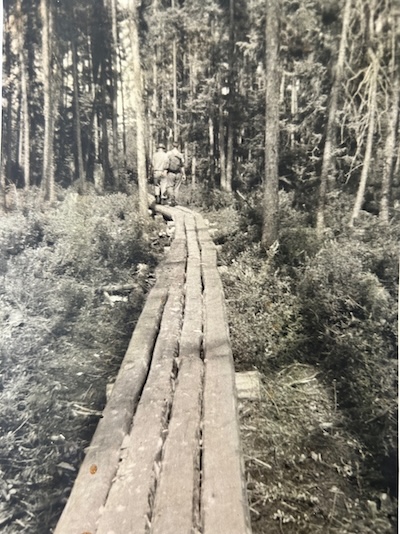
In the summer of 1937, he joined the Civilian Conservation Corps that was directed to build portages in the Boundary Waters Canoe Area. From that experience he went onto the University of Minnesota and majored in fisheries biology. After returning from service in WWII he got a job with the Department of Natural Resources. His main job in the field was to help build and maintain rivers and streams to make them healthy and viable environments for fish and other wildlife. It was said at his funeral he walked every river and stream in this state.
Today he would be heartbroken by this news:
"Trump overturns Superior National Forest mining ban. The president yesterday signed U.S. Rep. Pete Stauber's legislation that ends the Biden administration's 20-year mining ban on more than 200,000 acres in northeastern Minnesota.
"Trump's signature ends a "reckless policy that sidelined Minnesota’s miners and undermined our nation's ability to source our own materials," Stauber said in a statement.
"The ban's end means mining projects, including the proposed Twin Metals precious metals mine just a few miles from the Boundary Waters Canoe Area Wilderness, can now begin to move through state and federal environmental review and permitting processes again."
— The Minnesota Star Tribune 4/28/2026
Why does this matter?
This bill ending the mining ban is an unprecedented use of a procedural mechanism that will have far-reaching consequences for the Boundary Waters and other public lands across the country.
This million-acre wilderness is a transitional zone. It’s where species from the boreal and temperate hardwood forests blend. It’s a perfect habitat for old-growth cedars and other species. Some of the oldest trees including the white and red pine can live up to 400 years.
Few people are aware that more pioneering wilderness science has been conducted in the Boundary Waters than anywhere else in the United States. The BWCAW played an important role in the early development of wilderness science and contributed to better wilderness stewardship.
In September 2020, the International Dark-Sky Association announced its newest International Dark Sky Sanctuary: the Boundary Waters Canoe Area Wilderness. According to the IDA, the Boundary Waters is the world’s thirteenth location to receive this designation, and also its largest, at 1,098,000 acres. “This designation confirms what people in this area have enjoyed for thousands of years: naturally dark skies, starry nights, and astounding northern lights displays.”
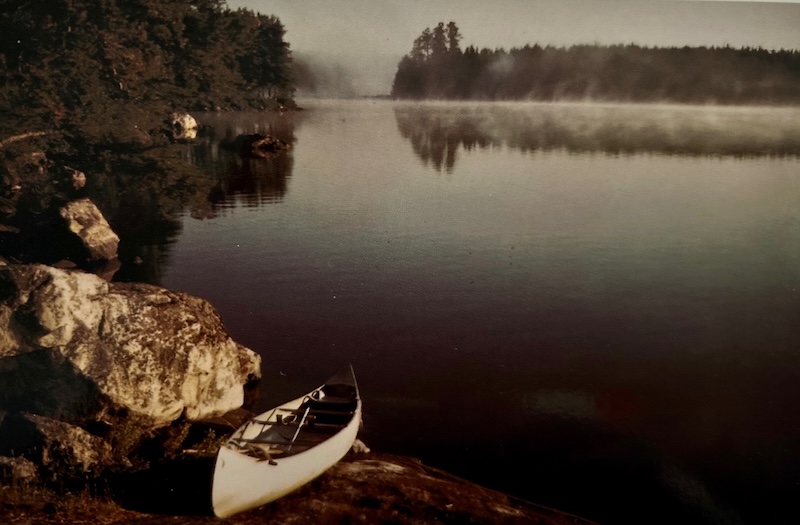
This cherished place has 1175 lakes connected by several hundred miles of streams. Its natural habitat is unique in its rich wildlife and rare arctic species. In addition to all of its waterways, here is a partial listing of some of the species living in the BWCA that can be affected by this new mining ruling.
150+ nesting bird species
snowy owl, long-eared owl, eastern whip-poor-will, red-headed woodpecker, olive-sided, flycatcher, wood thrush,
golden-winged warbler, connecticut warbler, cape may warbler, canada warbler, harris’s, sparrow rusty, blackbird,
evening grosbeak, american black duck, spruce grouse, sharp-tailed grouse, american woodcock, bald eagle...
gray wolf, red fox, lynx, fisher, pine marten, mink, otter, weasel, black bear, moose, beaver, red-backed salamander, southern bog lemming, northern leopard frogs, bats, white-tailed deer, porcupine, snowshoe hare, badger, white-tailed jackrabbit, coyote, snapping turtle, red squirrel, bobcat, chipmunk, muskrat
lake trout, walleye, northern pike, smallmouth bass, largemouth bass, perch, crappie, whitefish, sucker, sturgeon, burbot, crayfish…
blueberries, raspberries, wild strawberries, bearberries, bunchberries, Juneberries, thimbleberries, dewberries. spruce tips, wintergreen Labrador tea, fiddlehead ferns, chanterelles, chicken of the woods, oysters, morels, boletus, lobster mushrooms.
white cedar, red pine. eastern white pine, jack pine, birch, balsam fir, tamarack, white spruce, black spruce, blue spruce.
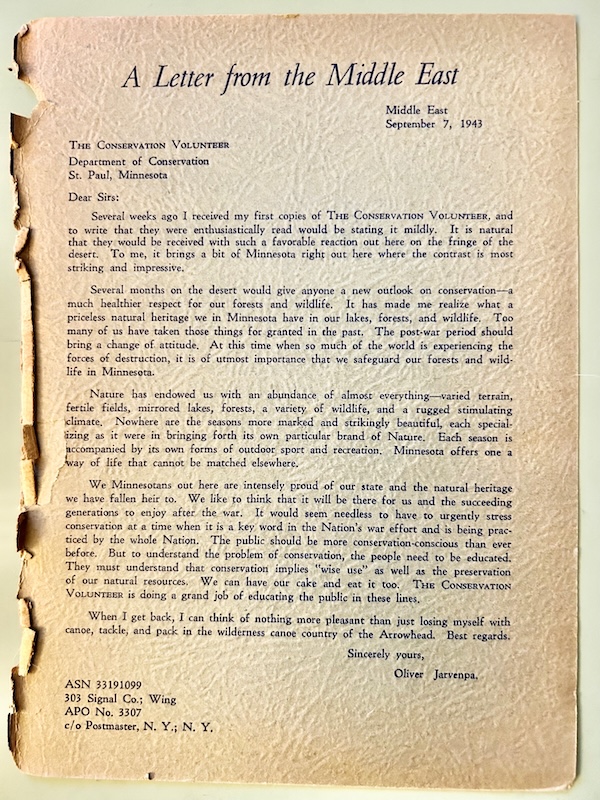
When my father was stationed in Libya in 1943, he wrote a letter to The Conservation Volunteer at the Department of Conservation in St Paul that they published on the back cover of their November-December issue. This is a passage from the letter.
"Several months on the desert would give anyone a new outlook on conservation. It has made me realize what a priceless natural heritage we in Minnesota have in our lakes, forests, and wildlife.
Too many of us have taken those things for granted in the past.
The post-war period should bring a change of attitude. At this time, when so much of the world is experiencing destruction, it is of the utmost importance that we safeguard our forests and wildlife in Minnesota. The public should be more conservation-conscious than ever before. We must understand that conservation implies “wise use” as well as preservation of our natural resources.
When I get back, I can think of nothing more pleasant that just losing myself with canoe, tackle, and pack in the wilderness canoe area of the Arrowhead."
— Oliver Jarvenpa, 1943
We can only hope with further work and legal responses we and other young men and women will have this same opportunity to canoe in a pristine and safe wilderness that this state has offered for thousands of years. Barry Lopez asked, “Is it still possible to face the gathering darkness and say to the physical Earth, and say to all its creatures, including ourselves, fiercely and without embarrassment, I love you, and to embrace fearlessly the burning world?” My father would have said, yes.
Never Forget How
To walk the fallen stars of trillium,
push paddle to island,
slip thirsty skin into liquid cobalt,
float in blossom of sleeping fish.
Witness and glide
along the thunderstruck
sweet rains of
a thousand threaded lakes.
And sing yourself to water.
— Diane Jarvenpa
Photos